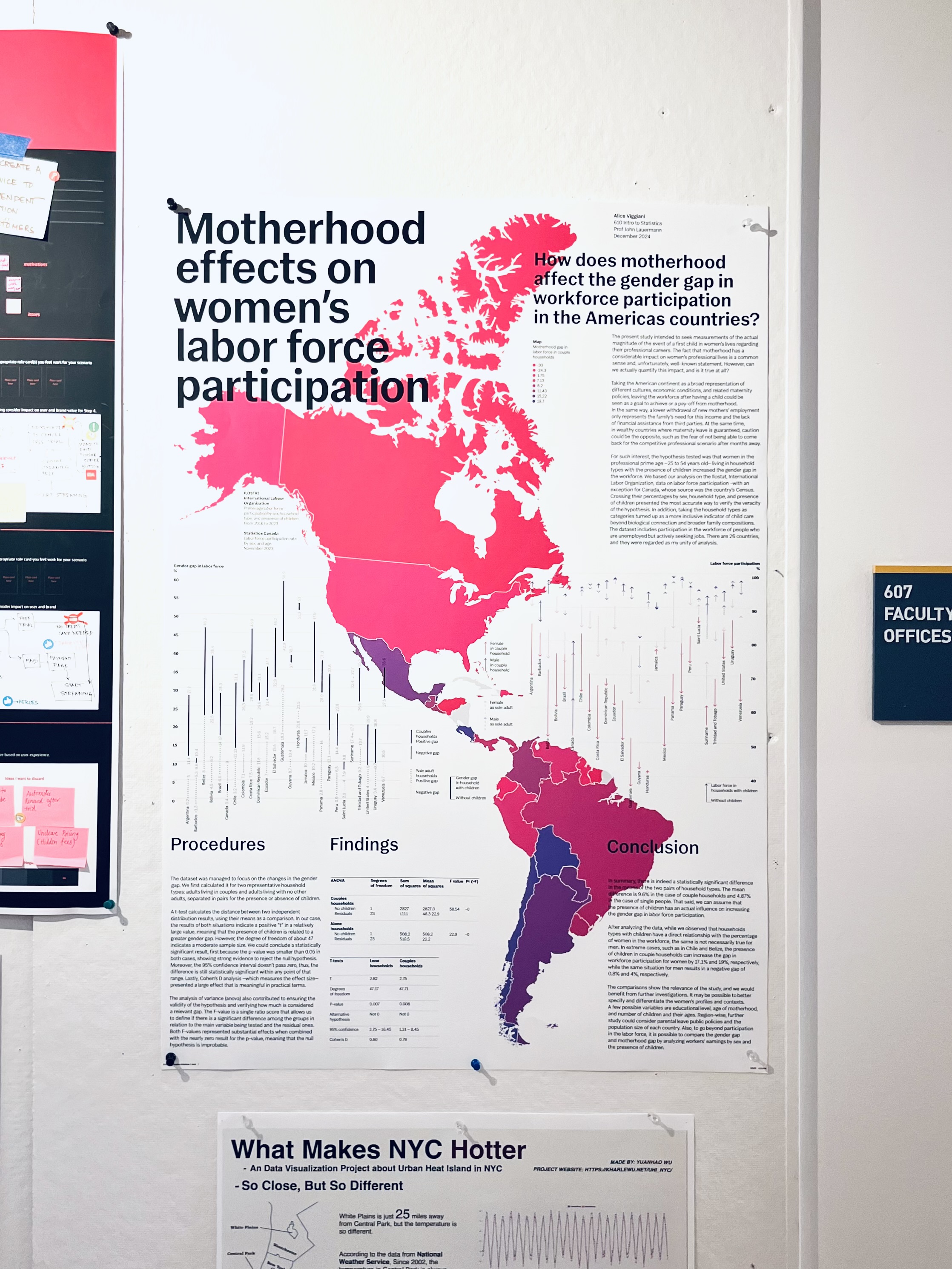
Does having a child measurably widen the gender gap in the workforce, or is that just common sense repeating itself? This project started as an assignment and grew into a full
case study testing that question across 26 countries in the Americas.
Using ILOSTAT labor force data
(and Canada's census), I split participation rates by sex, household type —couples versus adults living alone— and the presence of children, then ran
t-tests and an ANOVA on the results to see whether the gap held up statistically or was just noise
in a modest sample.
case study testing that question across 26 countries in the Americas.
Using ILOSTAT labor force data
(and Canada's census), I split participation rates by sex, household type —couples versus adults living alone— and the presence of children, then ran
t-tests and an ANOVA on the results to see whether the gap held up statistically or was just noise
in a modest sample.


Each arrow tracks one country's labor force participation rate,
from its rate in households without children to its rate in households with children, split by sex (pink for women, purple for men) and household type (solid arrows for couples, dashed for people living alone). The length and direction
of the arrow show how much participation shifts once children enter the household, almost always downward for women, rarely for men.
from its rate in households without children to its rate in households with children, split by sex (pink for women, purple for men) and household type (solid arrows for couples, dashed for people living alone). The length and direction
of the arrow show how much participation shifts once children enter the household, almost always downward for women, rarely for men.


To check whether that shift was more than anecdotal, I calculated the gender gap, the difference between men's and women's participation, for couples and single-adult households, with and without children, then tested it with paired t-tests and an ANOVA. Both returned p-values under 0.01 and a large effect size (Cohen's d of 0.80 for couples, 0.78 for singles), rejecting the null hypothesis: the presence of children is tied to a real, statistically significant increase in the gender gap, not just sampling noise.

On average, children in the household widened the gender gap by 9.6 percentage points for couples and 4.87 points for single adults. The pattern held almost everywhere, though its size varied widely,
in Chile and Belize, for instance, children raised women's participation gap by 17.1 and 19 percentage points, while men's participation in the same households barely moved. The comparison points to a real, quantifiable effect, though a small one next to the deeper structural questions it raises. I followed up on those questions in a longer paper, adding
a literature review and a case study of Iceland and Sweden's parental leave policies.
in Chile and Belize, for instance, children raised women's participation gap by 17.1 and 19 percentage points, while men's participation in the same households barely moved. The comparison points to a real, quantifiable effect, though a small one next to the deeper structural questions it raises. I followed up on those questions in a longer paper, adding
a literature review and a case study of Iceland and Sweden's parental leave policies.